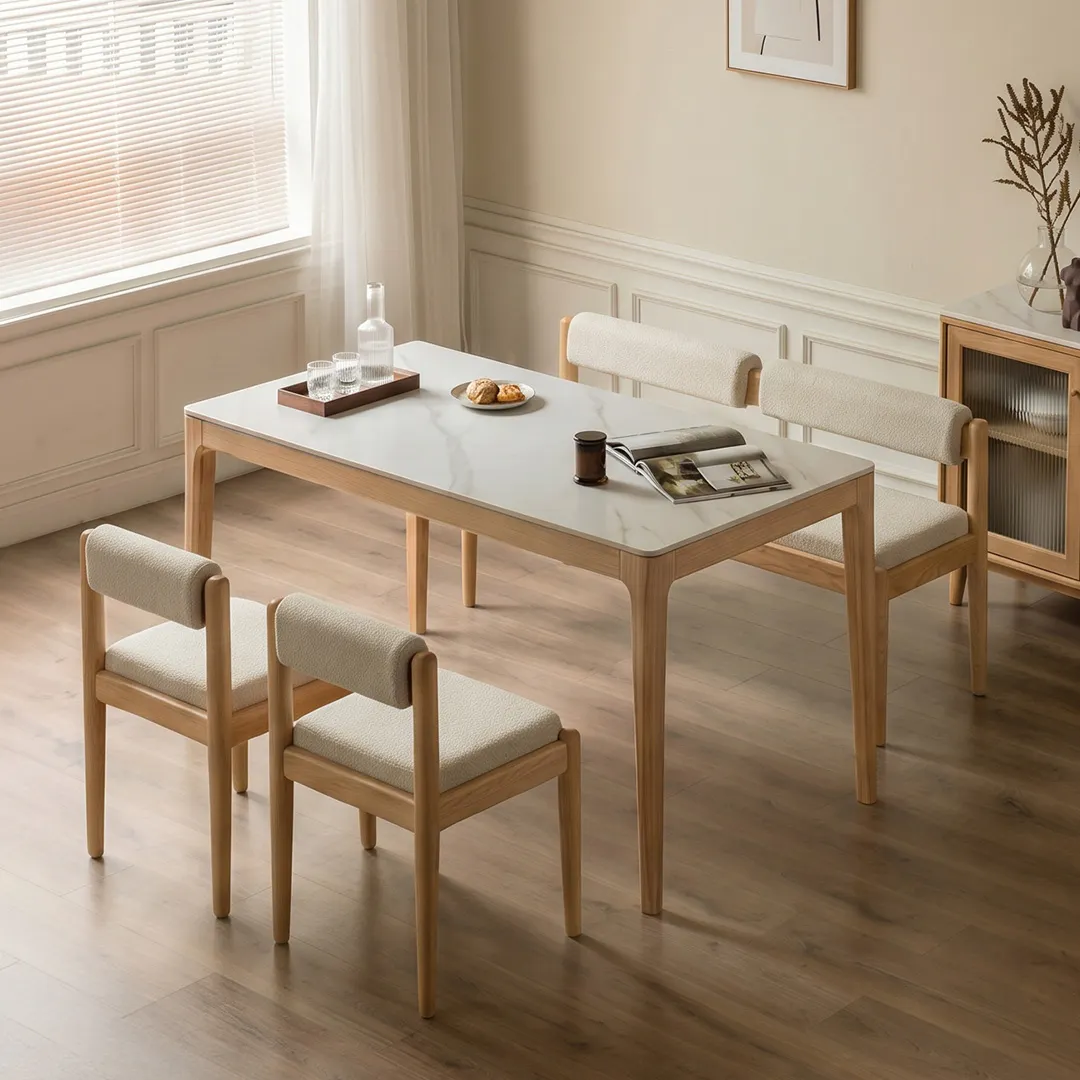
How to Choose a Dining Table in Singapore: Types & Materials
This guide walks through the seven decisions behind choosing a dining table in Singapore: shape, configuration, style, material, sizing, base and leg design, and a simple six-step framework to bring them together. Each one carries extra weight here, where a dining table has to earn its place on a compact HDB or condo footprint, hold up through years of humidity and double as a desk, a homework station and a hosting centrepiece between meals.
TL;DR: The Whole Guide in Seven Lines
- Shape: When it comes to dining tables, there are generally six shapes to choose from, and the table should match the room (rectangular or oval for long rooms, round or square for square ones).
- Configuration: Fixed is the simplest and sturdiest, but most Singapore homes do best with an extendable 4-seater that opens to 6 for guests.
- Style: Minimalist and Scandinavian dominate local homes, with Japandi rising fast.
- Materials: Sintered stone is the safe default, solid wood ages beautifully, glass suits compact spaces, and marble needs regular sealing.
- Sizing: Leave at least 75 cm of walkway clearance; a 4-room HDB comfortably takes a 4 to 6 seater.
- Base and legs: A pedestal base gives the most flexible seating and the best legroom for corner diners.
- Decision framework: Work through layout, seating, lifestyle, material, style and budget, in that order.
Short on time? The Material Comparison Table further down gives the at-a-glance verdict, and How to Choose Your Dining Table walks you through it step by step.
Dining Table Shapes
Every dining table starts with its shape, and the right shape is mostly decided by the shape of your room. The different types of dining tables, from the everyday rectangle to more design-led outlines, come down to six kinds of dining tables you will find in Singapore showrooms.
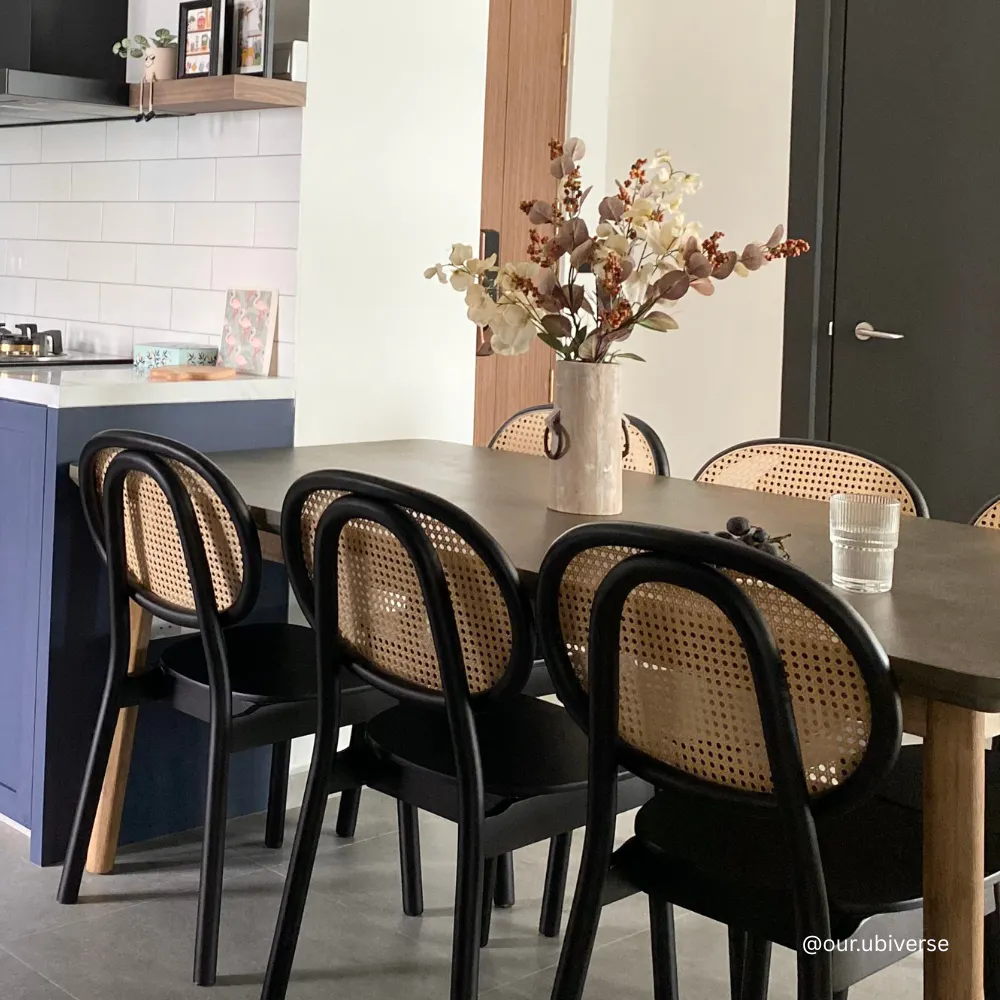
Rectangular
A rectangular table is the most common and most versatile shape, seating the most people for its footprint. It suits long, rectangular dining areas, which describe most HDB and condo layouts, and typically seats 4 to 8. Keep one long side near a wall to preserve walkways in tighter spaces.
Best for: rectangular rooms and larger households.
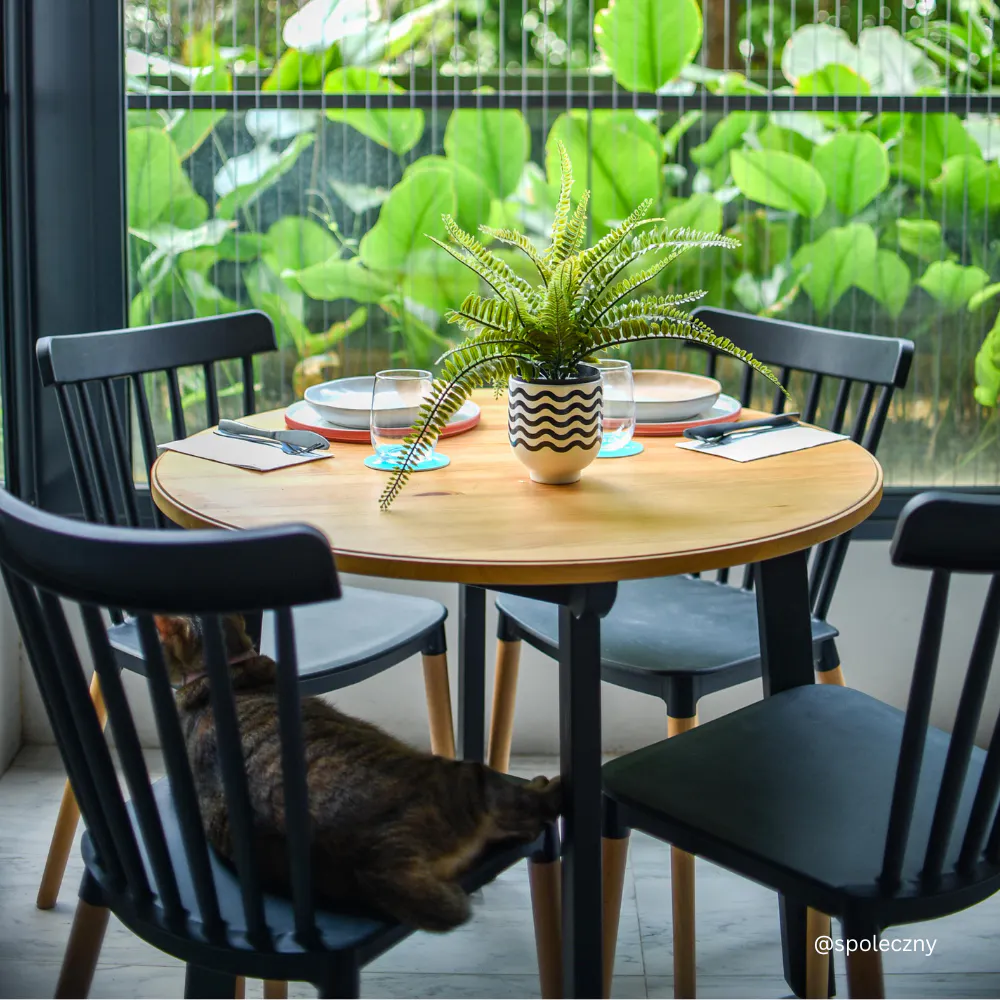
Round
A round dining table has no corners, so it improves traffic flow and makes conversation easy since everyone faces inwards. It fits square dining areas and small spaces, comfortably seating four (around 100 to 110 cm across), but feeling cramped beyond six. The lack of corners also makes it safer in homes with young children.
Best for: square rooms, small spaces and conversation-led dining.
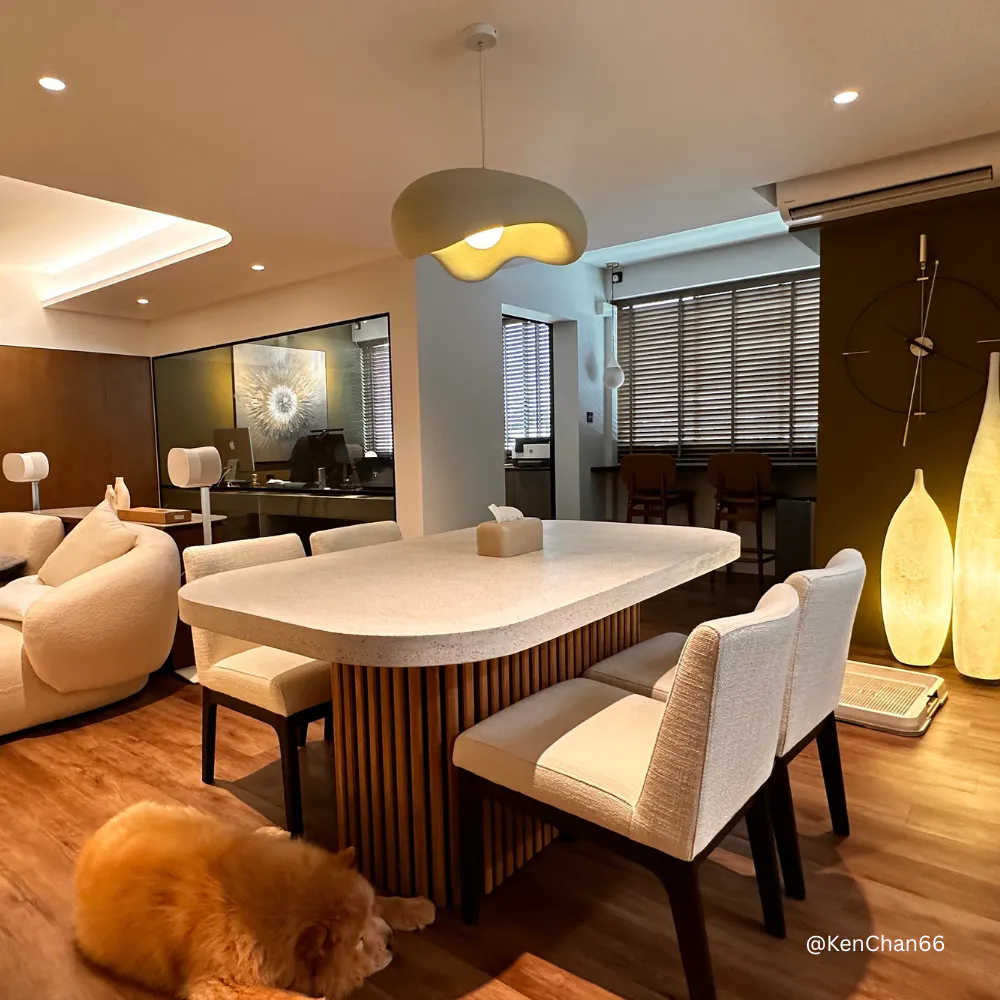
Oval
An oval table offers the seating capacity of a rectangle with softened, corner-free ends that ease movement around it. It suits rectangular and narrower rooms, seating 6 to 8 while feeling less bulky than a sharp-cornered rectangle. The rounded ends help in walkways where a square corner would catch hips and chairs.
Best for: rectangular rooms wanting a softer look.
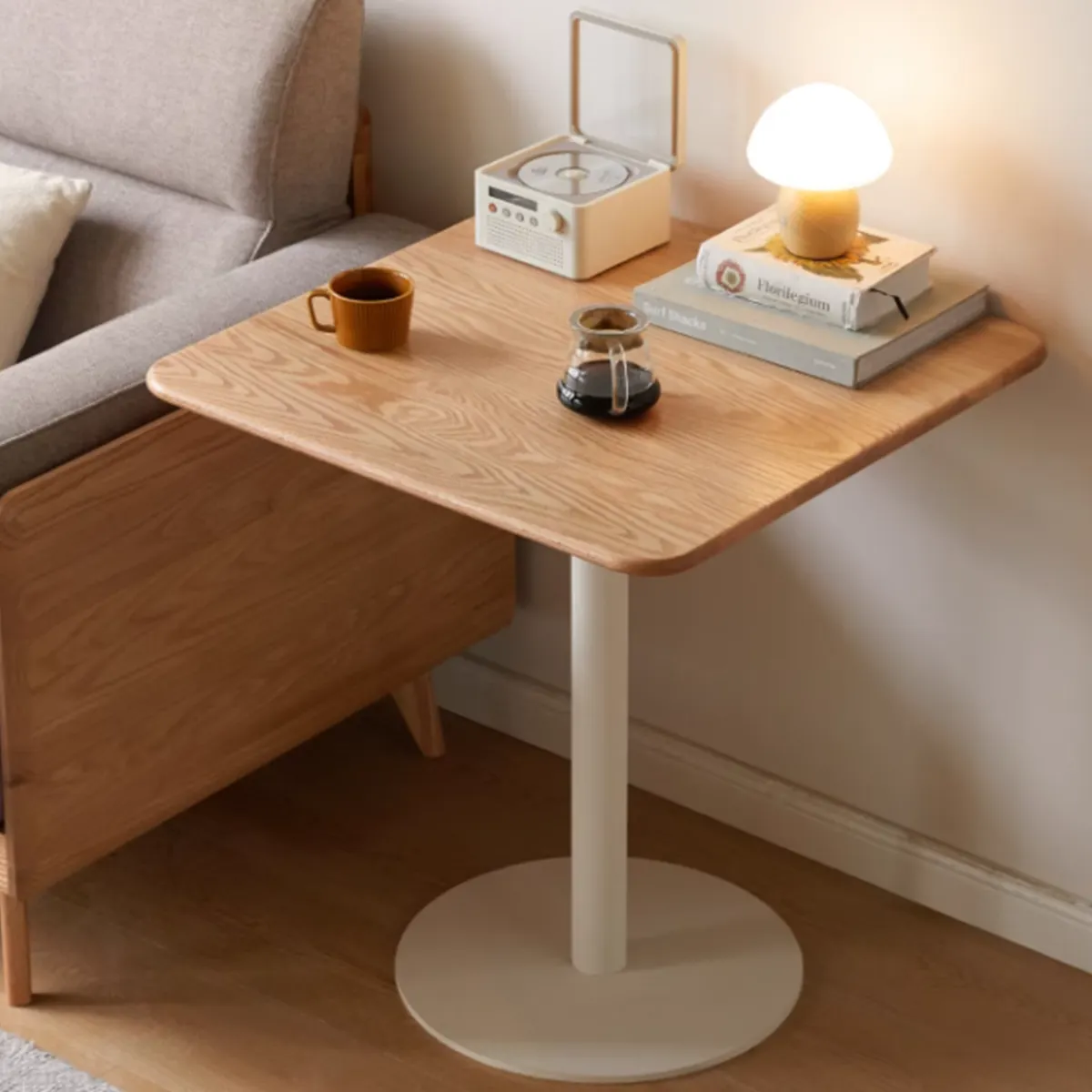
Square
A square table seats four evenly with an intimate, sociable feel, but it does not scale well beyond that. It is the natural match for a square dining area or a small flat, using its footprint efficiently for two to four diners. Push it against a wall to free up space when it is not in use.
Best for: square rooms and four-person households.
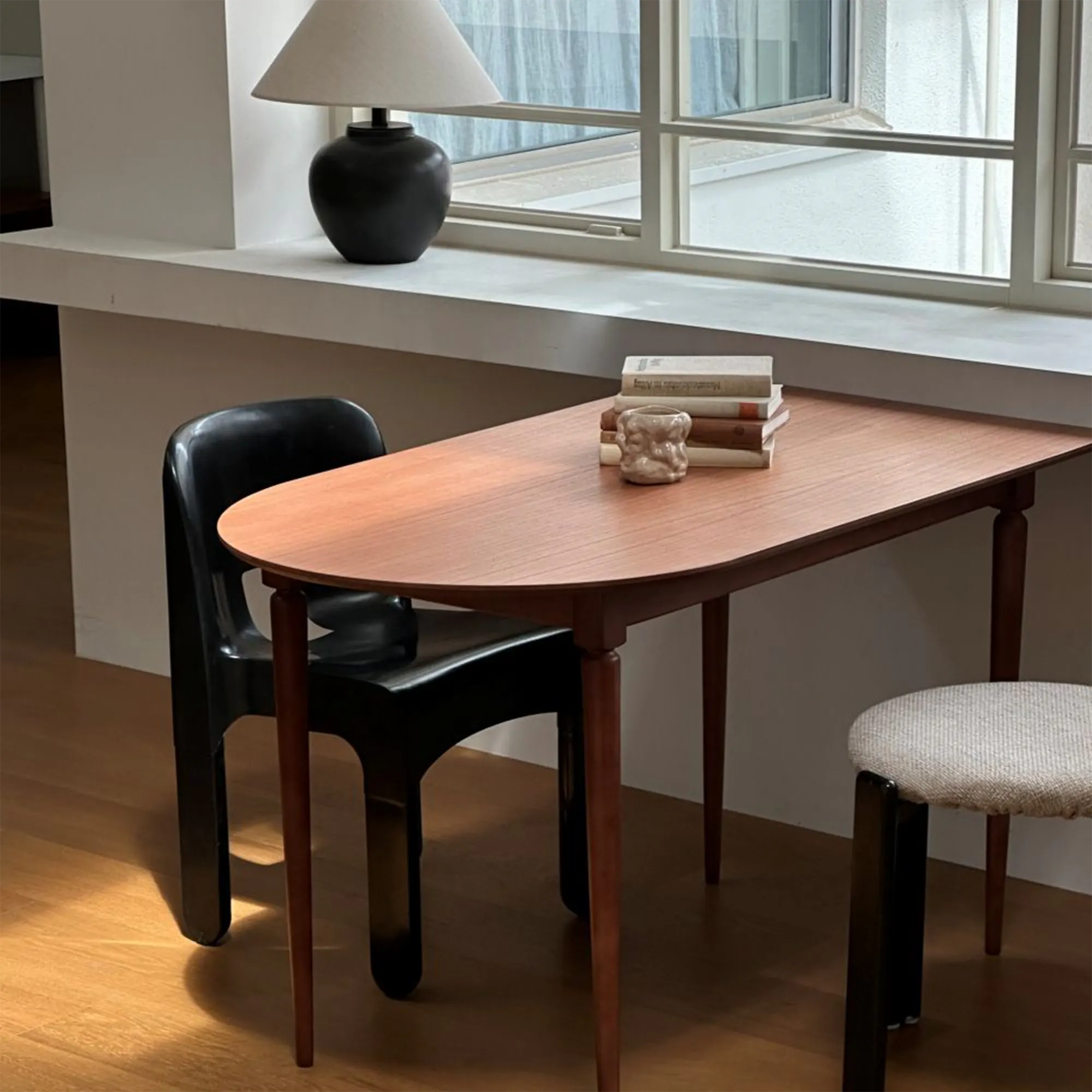
Half-Stadium (Racetrack)
A half-stadium table, sometimes called a racetrack, has a rectangular footprint with gently rounded short ends. This shape is ideal for narrow Singapore dining areas, because the rounded ends ease the squeeze in tight walkways while keeping the seating capacity of a rectangle. It is a quietly practical shape that many shoppers overlook.
Best for: narrow rooms that still need to seat six.
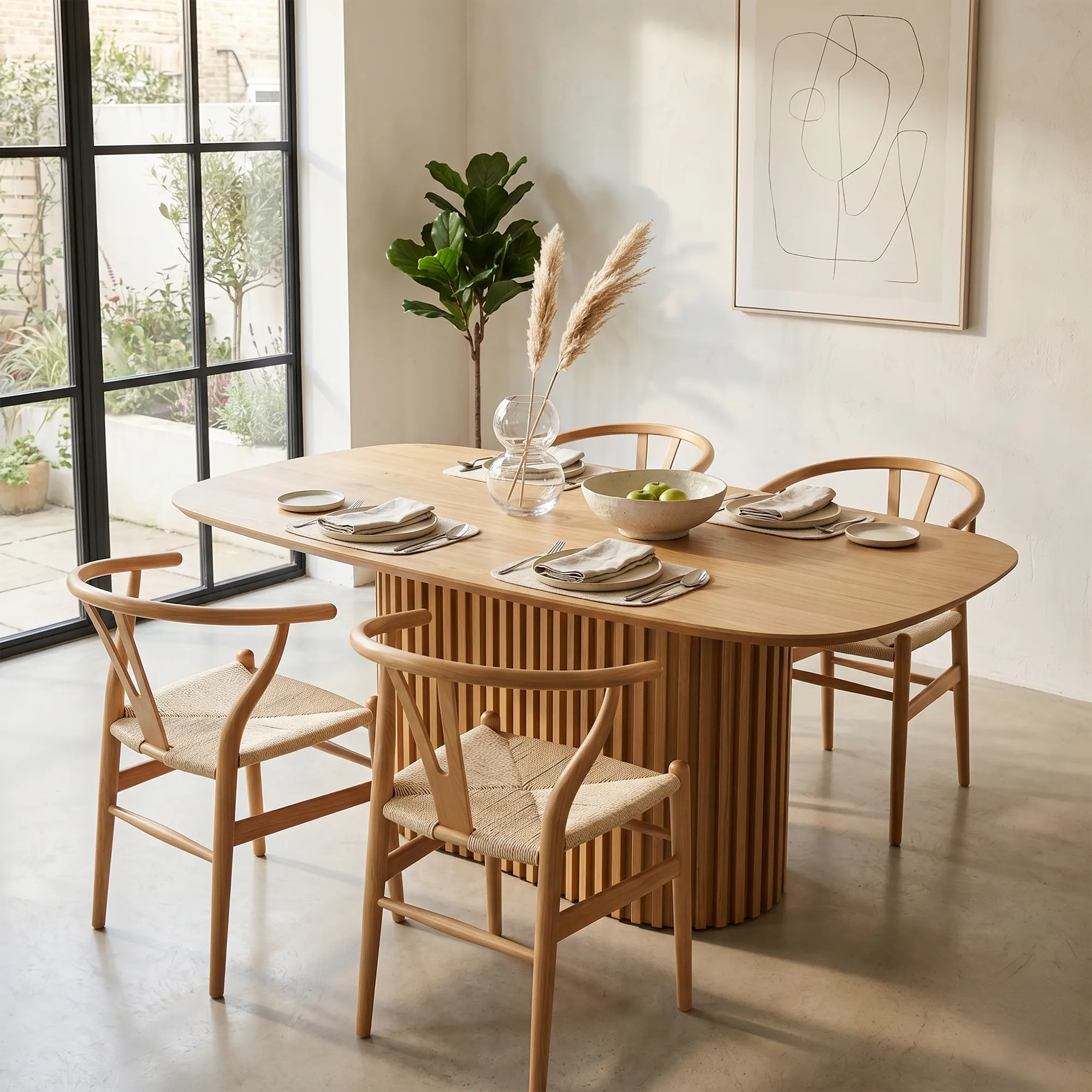
Boat-Shape
A boat-shaped table curves outwards to a wider centre and tapers towards each end, giving diners extra elbow room in the middle. It is a design-led shape that adds presence to larger dining areas and condos. The generous centre suits households that linger over long, leisurely meals.
Best for: larger, design-forward dining rooms.
A Quick Comparison of the Different Shapes of Dining Tables
| Shape | Typical seating | Best room shape | Best for | Best-fit SG home |
|---|---|---|---|---|
| Rectangular | 4–8 | Rectangular | Most households | 4-room HDB and up, condos, EC, landed |
| Round | 4–6 | Square / small | Conversation, kids | 3-room HDB, studio or 2-bed BTO, smaller condos |
| Oval | 6–8 | Rectangular / narrow | A softer look, kids | 4 to 5-room HDB, condos, EC |
| Square | 2–4 | Square / small | Couples, small flats | 3-room HDB, studio BTO, 1 to 2-bed condos |
| Half-stadium | 4–6 | Narrow | Tight walkways | 4-room HDB and BTO with narrow dining areas |
| Boat-shape | 6–8 | Large | Statement dining | EC, landed, larger condos |
Dining Table Configurations
While shape is about the table's outline, configuration is about whether and how the table changes size. Here are the five configurations and who each one suits.
-
Fixed
A fixed table has one permanent size, which makes it the simplest, sturdiest and most affordable option. With no moving parts, there is nothing to wobble or wear out, so it is the reliable default if your seating needs rarely change. Choose your size carefully, since you cannot adjust it later.
-
Extendable
An extendable dining table expands to seat extra guests and contracts back to save space, which makes it the most practical default for most Singapore homes. Three mechanisms are common: a butterfly leaf that folds out from inside, a draw-leaf that pulls from each end, and a flip-top that doubles over. A 4-seater that opens to six covers everyday meals and occasional hosting in a single piece.
-
Drop-Leaf
A drop-leaf table has hinged edges that fold down when not in use, shrinking its footprint dramatically. It is the best answer for very tight areas like studio condos and 3-room HDB flats, where it can sit slim against a wall and open up only at mealtimes. Capacity is modest, but the space saving is significant.
-
Convertible
A convertible table transforms from one piece of furniture into another, such as a console that unfolds into a dining table or a coffee table that lifts to dining height. It is the most space-efficient option for very small homes, though it is also the priciest per seat. It earns its keep when floor space is genuinely scarce.
-
Wall-Mounted / Fold-Down
A wall-mounted table folds flat against the wall when not in use, freeing the floor entirely. It is a niche solution best suited to very small studios or a BTO bedroom that needs an occasional work or eating surface. Seating is limited, but the footprint when folded is close to zero.
Whichever extending design you choose, test the mechanism in the showroom before you buy. A good extension glides smoothly and locks firmly with no wobble, while a poor one snags and loosens over time.
Dining Table Styles & Aesthetics
A dedicated look at dining table styles is rare, so here is the part most guides skip. These are eight different dining table styles and the concrete visual cues that define each, with a note on where each one fits in a Singapore home.
Minimalist / Contemporary
A minimalist dining table keeps its lines straight and clean, with a slim top, simple legs and a single uninterrupted colour. It suits compact flats where visual clutter shrinks the room, and it pairs with almost anything.
Mid-Century Modern
Mid-century dining tables feature tapered wooden legs, gently rounded edges and a warm wood finish, often in teak or walnut tones. The look suits homes that mix retro warmth with a relaxed, lived-in feel.
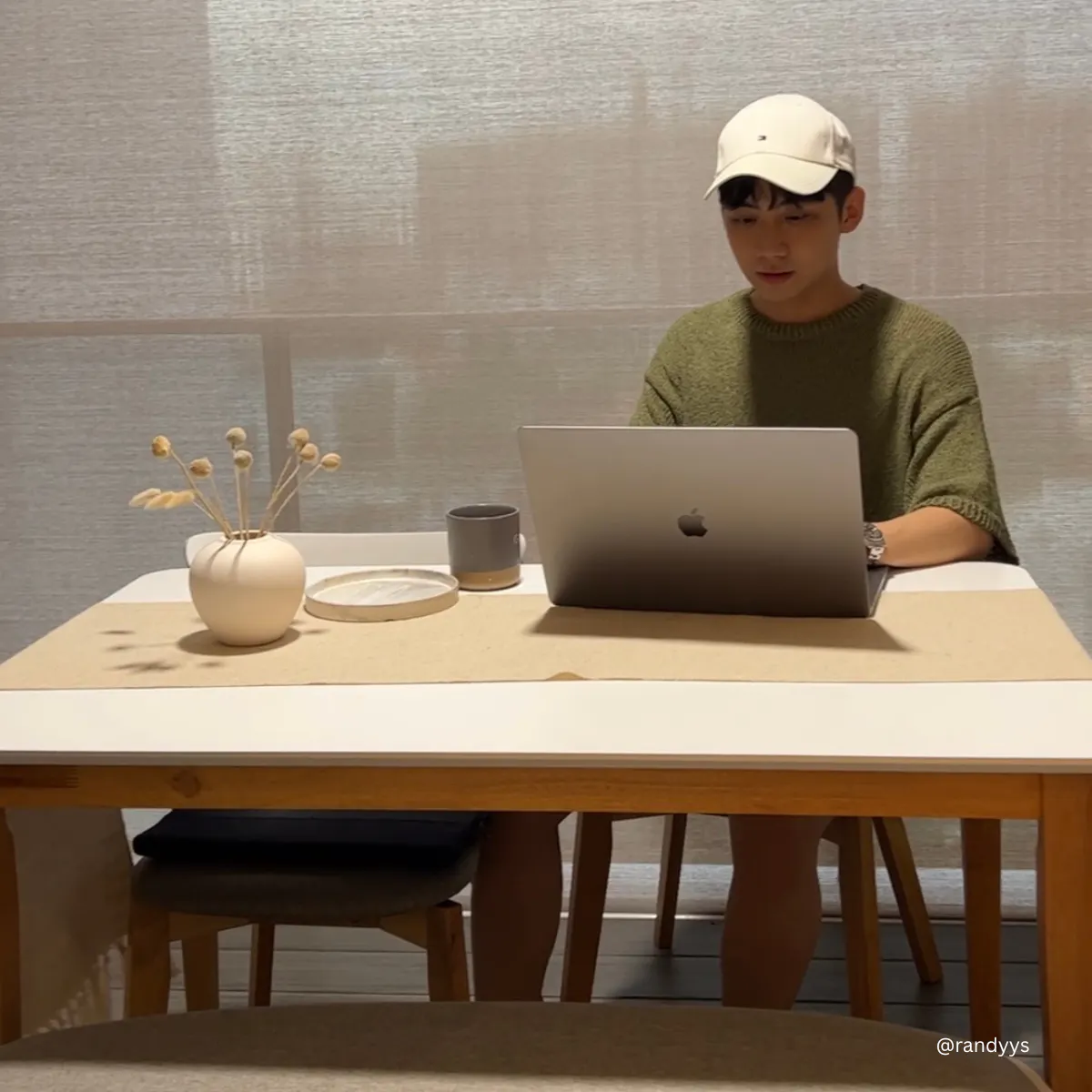
Scandinavian
Scandinavian dining tables use light wood such as pale oak or ash, slim legs and soft, rounded forms for an airy, uncluttered look. This is one of the rising defaults in Singapore BTO and condo homes, pairing naturally with white walls and bright interiors.
Japandi
Japandi style dining tables blends Japanese restraint with Scandinavian warmth: low-slung proportions, natural matte finishes and muted earthy tones. It is climbing fast in local homes that favour calm, intentional spaces with fewer, better pieces.
Industrial
Industrial tables combine a dark or raw wood top with an exposed black metal frame and boxy, sturdy lines. The style suits loft-like condos and homes with concrete, brick or dark accents.
Traditional / Classic
Traditional tables are defined by turned or carved legs, richer dark wood and substantial, formal proportions. They anchor homes that lean timeless and host more formal sit-down meals.
Farmhouse / Rustic
Farmhouse tables feature a thick, chunky wood top, visible grain and solid trestle or block legs for a warm, homely look. They suit larger homes and families who want a relaxed, gather-round centrepiece.
Glam / Luxe
Glam tables make a statement with marble or glass tops, metallic gold or chrome bases and high-shine finishes. The look is striking, but it dates faster than minimalist or Scandinavian styles, so weigh that against how long you plan to keep the table.
In a Singapore HDB or BTO, where you may live with the same table for a decade or move it between homes, the styles that age best are the understated ones. Minimalist, Scandinavian and Japandi pieces stay relevant through changing trends and adapt to new spaces, while bolder, more decorative looks can feel dated sooner. Choosing a style that ages well is often the most cost-effective decision you make.
Dining Table Materials
Material is the single biggest decision factor for a Singapore dining table, because it determines how the table copes with humidity, heat, scratches and daily spills, and whether it still looks good in ten years. Before the individual materials, four quality markers apply across all of them.
-
Tabletop Thickness
Thickness signals quality and stability. Solid wood and stone tops are typically 25 to 40 mm thick, which resists bowing, while thinner engineered-wood tops tend to sag or bow over time, especially under the weight of serving dishes.
-
Edge Finish
The edge shapes both look and durability. Square-cut edges look crisp but chip more easily; bevelled and bullnose (rounded) edges tolerate knocks better and are kinder in homes with children; live-edge keeps the natural wood profile for a rustic statement.
-
Top-to-Base Join
How the top meets the base reveals build quality. A hidden bracket or apron is the mark of a well-made table, while visible screws driven through the top, or a glue-only join, point to a shortcut that loosens over time.
-
Surface Finish & Sealant
The finish affects daily life with the table. Matte and satin finishes on wood hide fingerprints and minor scratches better than high gloss; honed (matte) stone is more forgiving than polished; the finish you choose changes how the surface shows prints and wears.
With those markers in mind, here is how each material actually performs in a Singapore home, starting with solid wood.
Solid Wood Dining Tables
Solid wood dining table used the most traditional dining table material, and the most forgiving of time. It is warm underhand, repairable when scratched or dented, and it ages into a richer patina rather than out of fashion. The trade-off in Singapore is that it must be sealed and cared for against humidity.
-
Rubberwood
Rubberwood is the budget-to-mid default in Singapore, and it is often unfairly dismissed. It is genuinely hard, comparable to ash, and lighter than oak, which makes it easy to move and reasonably humidity-tolerant once properly sealed. Its affordable price band makes it the value pick for first homes.
-
Oak
Oak is a mid-tier hardwood with good humidity tolerance and a versatile, light-to-medium grain that suits most styles. It is harder than rubberwood and holds up well to daily family use. The price sits comfortably in the middle of the solid-wood range.
-
Walnut
Walnut is a mid-premium hardwood prized for its rich, dark, characterful grain. It is slightly softer than oak, so it shows dents a little more readily, but its depth of colour makes it a standout centrepiece. Expect a higher price band than oak.
-
Teak
Teak is the premium choice and the most humidity- and water-resistant solid wood, thanks to a high natural oil content that suits our climate well. It carries a premium price, and it is worth confirming the timber is responsibly sourced, as teak sustainability is a genuine concern.
Whichever species you choose, sealing is non-negotiable here. Poorly sealed solid wood will cup, crack or split within three to five years in Singapore’s humidity, so confirm the finish and follow the care routine.
Engineered Wood Dining Tables
Engineered wood is a useful structural material, but a fully engineered-wood tabletop is rarely worth it for daily dining in Singapore. Here are the three types and where each one belongs.
-
Plywood
Plywood is layers of wood veneer glued in alternating directions, which makes it the strongest of the engineered woods and the most resistant to warping. It is excellent for frames, legs and internal structure, but it still needs a robust veneer or laminate surface over it to serve as a tabletop.
-
MDF
MDF (medium-density fibreboard) offers a perfectly smooth surface for paint or laminate, which is why it is so common. The drawback is moisture: MDF absorbs it, and in Singapore's humidity, the edges tend to chip and peel within three to five years of daily wipe-downs.
-
Particleboard / Chipboard
Particleboard is the cheapest engineered wood, made of wood chips bound with glue, and it has very low humidity tolerance. It is the material behind most flat-pack budget tables, and it swells and crumbles once moisture gets in.
Before you buy: Always check the product description for the specific wood or top material rather than going by price alone. Plenty of affordable tables use quality plywood or veneered surfaces, while others rely on particleboard, and the spec sheet is the only reliable way to tell which is which.
The buying rule is simple: Use engineered wood for the legs, aprons and frame, not for the surface you eat off. The one exception is a quality veneered top, covered next.
Veneered Dining Table Tops
Veneer is a thin surface layer bonded over a structural core, and the three types span roughly a fivefold quality range. In practice, most quality dining tables on the market, including the ones we would point you towards, are real oak veneer over an engineered-wood core.
-
Real Wood Veneer
Real wood veneer is a slice of genuine wood, often around 0.6 mm, bonded over a stable engineered core, and from above it looks identical to solid wood. Counterintuitively, thinner veneers bond more reliably, while thicker veneers, around 3 mm, are more prone to peeling over time. It usually cannot be re-sanded, so treat the surface gently.
-
High-Pressure Laminate (HPL)
High-pressure laminate is a printed, textured surface bonded under heat and pressure, and it convincingly mimics wood, marble or stone. It resists scratches, heat and stains well, which makes it a pragmatic mid-tier choice for busy households. It is the sensible pick when you want a hardy surface without a natural-material price.
-
Melamine
Melamine is a thin paper-and-resin surface and the cheapest of the three. It chips easily at the edges and lifts with prolonged moisture, which makes it common on budget flat-pack tables but a poor long-term bet in our humidity.
The buying rule: if a table looks like wood but the price seems too good to be true, it is almost certainly melamine, not veneer.
Glass Dining Tables
Glass visually opens up a small Singapore dining area by letting light through and showing the floor beneath, but the type of glass decides whether it survives a decade of daily use.
Tempered vs Ordinary Glass
Tempered (toughened) glass is heat-treated to four or five times the strength of ordinary glass, and if it ever breaks it crumbles into small, blunt pebbles rather than dangerous shards. It is the only safe choice for a dining table, so look for a "tempered" or "toughened" stamp etched in a corner. Ordinary annealed glass cracks under thermal shock and breaks into long, sharp shards, and it is sometimes used on cheap tables where it should not be.
Three honest trade-offs come with any glass top:
- Fingerprints: Glass shows every print and smudge, so a daily wipe-down is non-negotiable.
- Scratches: It resists scratching reasonably well, but fine hairline marks from cutlery accumulate over the years.
- Light reflection: Glass amplifies harsh pendant lighting, while frosted or tinted glass softens the glare.
Glass is best for homes without young children or boisterous pets, where keeping up the daily wipe-down is easy.
Marble Dining Tables
Marble is the most aspirational dining table material and the most demanding, and it splits into two very different categories that most retailers do not explain.
-
Natural Marble
Natural marble is quarried stone, such as Carrara, Calacatta or Statuario, with veining unique to each slab. It is porous, so it scratches under a knife edge and etches within minutes from acidic spills, and it needs resealing every 6 to 12 months. It is beautiful, but it asks for genuine commitment.
-
Engineered /Cultured Marble
Engineered marble is crushed marble bound with resin, which makes it harder, less porous and more stain-resistant than natural stone. It is more forgiving in daily use, though it is distinct from sintered stone, which performs differently again.
Three care realities come with marble:
- Sealing: Test the seal by dripping water on the surface; if it stops beading, it is time to reseal, usually every 6 to 12 months.
- Acidic foods: Citrus, tomato, wine and coffee etch almost instantly, so wipe them up immediately.
- Heat: Marble tolerates heat to around 300 °C, but rapid temperature changes can cause hairline cracking, so always use trivets.
The buying rule: if you want the marble look without the upkeep, sintered stone is the better answer.
Sintered Stone & Ceramic Dining Tables
Sintered stone dining table (man-made natural stone particles compressed under heat and pressure) has become the safe default for dining tables in Singapore as they handle heat, scratches, stains and humidity better than any alternative while offering marble looks with almost no maintenance.
However, three honest trade-offs balance the picture:
- Weight: A 6-seater slab runs 80 to 120 kg, so check that the base and your floor can take the load.
- Edge chipping: Corners can chip if struck hard, though rounded corners reduce the risk.
- Price: Expect two to three times the cost of a comparable laminate-on-MDF table.
Ceramic is a close relative, thinner and lighter than sintered stone and slightly less heat-resistant. The two are often confused in marketing, so check the spec rather than the label. For a table that handles daily family life without a second thought, sintered stone is the answer most retailers will now guide you towards.
Metal & Terrazzo Dining Tables
Metal dining table in residential dining usually means a steel or iron base paired with a wood, glass or stone top, since pure metal tabletops are rare in local homes. Powder-coated steel is the most rust-resistant option in our humidity, while bare steel develops a patina that some buyers actively prefer. Metal-framed tables suit industrial and modern-rustic interiors, bringing a sturdy, structural look that pairs well with warmer top materials.
Terrazzo is a composite of marble, granite, glass or quartz chips set in cement or resin. It carries real nostalgia in Singapore, where it once covered HDB floors, and it is back in fashion as a marble alternative. It is more forgiving than marble but still porous, so it needs sealing, and its speckled rather than veined look gives a room a strong material identity for buyers who want one.
Both are niche, and specifically the right call for buyers committed to an industrial look (metal) or an eclectic, retro one (terrazzo).
Material Comparison Table for Singapore Homes
Here is how the materials compare on the things that matter most in a Singapore home.
| Material | Heat Resistance | Scratch Resistance | Stain Resistance | Humidity Tolerance | Ease of Care | Indicative Price Band |
|---|---|---|---|---|---|---|
| Solid teak | Good, use trivets | Moderate | Good when oiled | Excellent | Moderate, oil periodically | Premium |
| Solid walnut | Moderate | Moderate (soft) | Moderate | Good when sealed | Moderate | Mid–Premium |
| Solid oak | Moderate | Good | Moderate | Good when sealed | Moderate | Mid |
| Solid rubberwood | Moderate | Moderate | Moderate | Good when sealed | Moderate | Budget–Mid |
| Real wood veneer (on engineered wood) | Moderate | Moderate | Moderate | Good | Easy, never refinish | Mid |
| High-pressure laminate | Good | Very good | Very good | Very good | Very easy | Budget–Mid |
| Melamine | Poor | Poor, chips | Fair | Poor, edges peel | Easy but fragile | Budget |
| Tempered glass | Good | Fair, hairlines | Excellent | Excellent | Easy, shows prints | Mid |
| Natural marble | Good, use trivets | Poor, scratches | Poor, etches | Good when sealed | High, reseal often | Premium |
| Engineered marble | Good | Fair | Good | Good | Moderate | Mid–Premium |
| Sintered stone | Excellent (300C+) | Excellent | Excellent | Excellent | Very easy, no sealing | Mid–Premium |
| Ceramic | Very good | Very good | Excellent | Excellent | Very easy | Mid |
| Terrazzo | Good | Good | Fair, porous | Moderate when sealed | Moderate, reseal | Mid–Premium |
| Metal (base) | Excellent | Good | Good | Good if powder-coated | Easy | Varies |
If you only have 30 seconds: For most Singapore homes, sintered stone, quality oak veneer on engineered wood and solid rubberwood offer the strongest balance of durability, low maintenance and value.
Dining Table Sizing for Singapore Homes
The right dining table size comes down to three things: how much eating space each person needs, the walkway clearance around the table, and matching the seating capacity to your wall length.
-
Per-Person Eating Space
Allow about 60 cm of table width per diner, the local industry standard, so each person has room to eat without knocking elbows. Add another 10 to 15 cm per person if serving dishes will sit down the centre of the table.
-
Walkway Clearance
Leave at least 75 cm between the table edge and the nearest wall or furniture, which is the absolute minimum for pulling a dining chair out and walking behind it. Around 90 cm is the comfortable ideal where space allows.
-
Standard Dimensions by Seater
As a guide, a 4-seater rectangular dining table is roughly 120 x 75 cm; a 6-seater dining table is 160 to 180 x 80 to 90 cm; an 8-seater dining table is 200 to 220 x 90 to 100 cm; and a round 4-seater is about 100 to 110 cm in diameter. Standard table height is around 75 cm.
-
Guidance by Home Type
- 3-room HDB or studio BTO: a 4-seater fits comfortably.
- 4-room HDB: a 4 to 6 seater works well, and an extendable four-that-opens-to-six is the smart middle ground.
- 5-room HDB, executive or condo: a 6 to 8 seater fits comfortably.
- Landed homes: 8-seaters and larger open up.
Before committing, mark the table's footprint on your floor with masking tape, place your chairs around it, and walk the route you would take to the kitchen. It is the cheapest way to catch a too-big table before it arrives.
Dining Table Base & Leg Considerations
The base and legs decide how many chairs tuck under the table, how flexible your seating is, and whether corner diners are comfortable, so they deserve as much thought as the top.
-
Four-Leg
A four-leg base is the most common and the sturdiest, with a leg at or near each corner. The drawback is that corner diners can end up with a leg between their knees if the legs are heavily inset, so check the leg position against where people will actually sit.
-
Pedestal
A pedestal base uses a single central column or a splayed central support, which clears the perimeter entirely for maximum legroom and flexible seating. No diner is blocked by a leg, making it the most accommodating base for squeezing in an extra chair. Stability depends on a suitably weighted base.
-
Trestle / Sled
A trestle or sled base uses two solid panel supports set in from the ends. This gives good legroom along the centre and a distinctive, architectural look, but it leaves little leg space for anyone seated at the very ends.
There is also the matter of legroom and chair tuck-in. Aprons, the rail running under the tabletop, reduce knee clearance, so tables with a thin apron or none at all accept taller chairs more easily. If you are using armchairs, check that the armrests clear both the apron and the table edge when the chair is fully tucked in, or they will jut out into the walkway. A neat solution is the half-armrest chair, whose armrests stop short of the seat front: these allow a full tuck-in even under tables with deeper aprons, which is worth knowing if you love the armchair look but have a table with a substantial apron.
The showroom test settles it: sit in your preferred chair style, tuck fully in, and cross your legs. If a leg or apron gets in the way, it is not the table for you.
Dining Table Care & Maintenance
A well-cared-for dining table lasts 10 to 20 years. Here is how to get there for each material, with Singapore's humidity in mind.
-
All Tables
Tighten the base bolts every six months, keep the table out of direct sunlight to prevent fading, and use placemats and trivets to protect the surface from heat and scratches.
-
Solid Wood
Dust weekly and wipe spills immediately with a damp (not wet) cloth. Oil or wax every 6 to 12 months to feed the timber, and on delivery, leave it 7 to 10 days to acclimatise to your home's humidity before heavy use.
-
Real Wood Veneer
Care for it much like solid wood, but never sand or refinish it, since the veneer layer is too thin. Use a veneer-safe wax or polish and wipe spills promptly.
-
Laminate & Melamine
Clean with water and a microfibre cloth only. Avoid abrasive scourers, which dull and scratch the surface, and keep moisture away from any exposed edges.
-
Glass
Wipe daily with glass cleaner or warm soapy water, using a microfibre cloth to avoid lint streaks. Deal with fingerprints as they appear to keep the surface clear.
-
Marble & Engineered Marble
Wipe acidic spills immediately, reseal every 6 to 12 months, and always use trivets for hot pots. Skip vinegar and citrus-based cleaners, which etch and dull the stone.
-
Sintered Stone
The lowest-maintenance surface of all: wipe with water and a little dish soap, and lift stubborn marks with a baking-soda paste. No sealing is ever required.
Whatever the material, rotate seating positions from time to time so one section of the surface does not wear or mark faster than the rest.
How to Choose Your Dining Table
Here is how to choose a dining table in Singapore in six steps, each built around one question you can ask yourself. It is the part to bookmark if you are still working out how to choose a dining room table that genuinely fits your space.
- Start with your layout: what shape and size does the room allow? Map your dining area first, including its shape, its dimensions and where the walkways run. The room decides your table's shape and its maximum footprint long before style does, so measure before you fall for anything.
- Count your seats: who eats here daily, and how often do you host? Tally your everyday diners, then think about how often guests come over. Daily users set your base seater count, while hosting frequency decides whether you need a fixed table or an extendable one that opens up for visitors.
- Factor in lifestyle: does the table double as a desk or hobby surface? Be honest about the table's real job. If it hosts work-from-home days, homework and craft projects as well as meals, you need a more durable, scratch- and stain-resistant surface than a meals-only table.
- Match the material to your maintenance appetite. Decide how much upkeep you will realistically do. Low-maintenance surfaces include sintered stone, laminate and glass; solid wood and real veneer sit in the middle; marble is high-maintenance and only worth it if you enjoy the ritual.
- Choose a style that suits your existing room. Look at what you already own, your wood tones, your wall colours and the overall mood, then pick a table style that sits alongside them (see the styles section above). One coherent thread keeps the room from looking mismatched.
- Set a realistic budget. Anchor your expectations with rough benchmarks: around SGD 800 buys a laminate-on-engineered wood (MDF) table, about SGD 1,500 a solid rubberwood one, and SGD 2,500 or more moves you into sintered stone or solid oak and walnut. Spending a little more on the top and the joint usually buys years of extra life.
Still weighing it up? The FAQs below tackle the questions we hear most often.