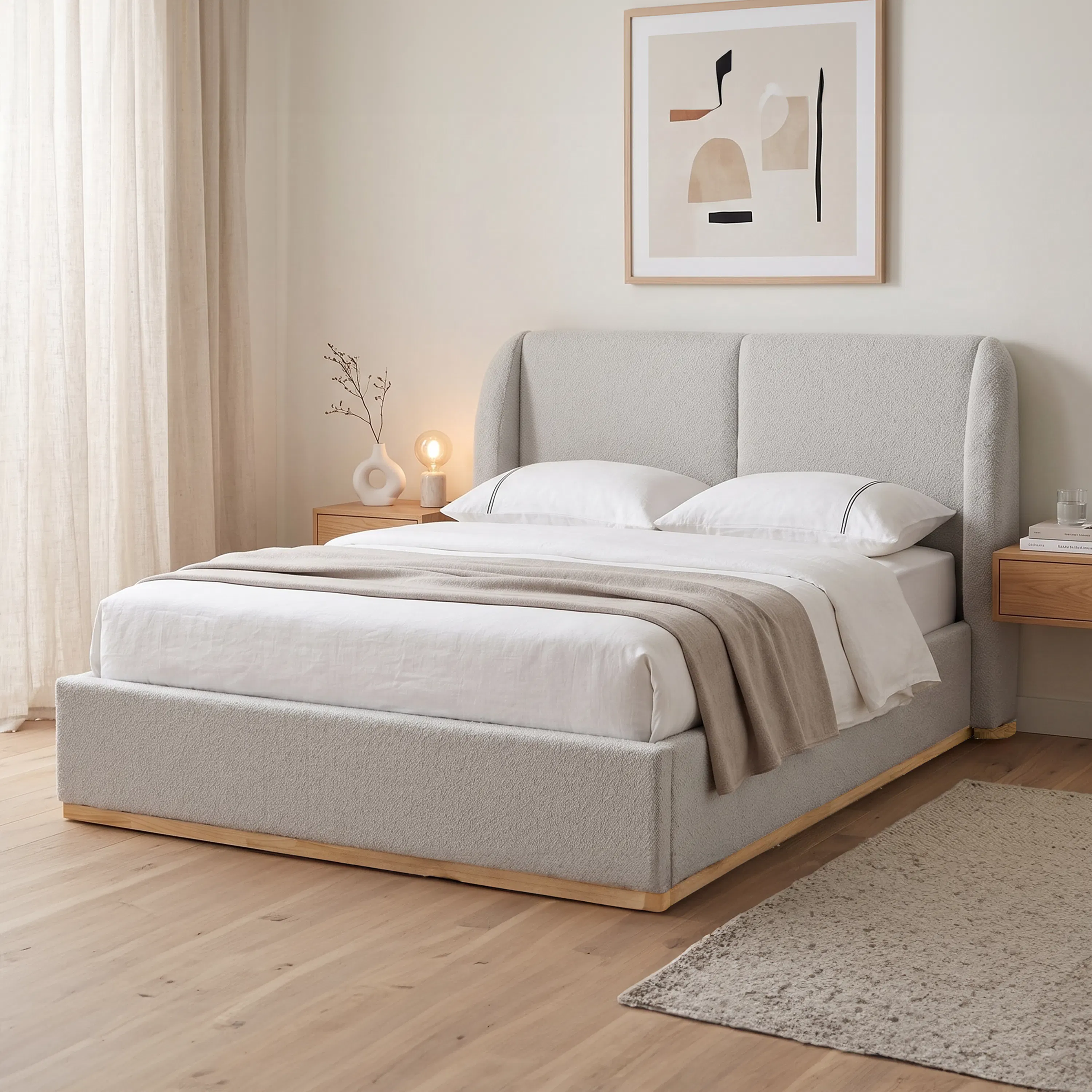
How to Choose a Bed Frame in Singapore: Types & Materials
A bed frame is the longest-serving piece of furniture in most bedrooms, quietly holding up your mattress for ten years or more while everything around it gets swapped out. Getting it right in Singapore means matching the frame to your mattress type and bedroom size, and choosing a material that shrugs off humidity and termites rather than warping or rusting within a few years. This guide covers the five things that decide all of that: bed frame types, styles, materials, sizing for local homes, and a step-by-step framework to pull it together.
TL;DR: A Quick Chooser
- Types: There are nine main types of bed frames, from simple slat bases to storage and adjustable beds; match the type to your mattress and your need for under-bed storage.
- Styles: Eight looks, from minimalist to rustic farmhouse; pick one that suits the rest of your room.
- Materials: Solid wood ages best, cheap engineered wood struggles in our humidity, powder-coated metal is the most rust-resistant, and upholstered frames add warmth and texture with a little easy care.
- Sizing: Size the bed to your tallest sleeper plus 10 to 15 cm, leave about 1 m of clearance on the access side, and check your lift and stairwell before ordering.
- Mattress pairing: Bonnell spring mattresses suit a solid base, pocket spring works on either solid or slat, and memory foam or latex sit happily on both, with slats simply helping airflow.
- Decision framework: Work through mattress, room size, storage, material, style and budget, in that order.
Short on time? The Material Comparison Table further down gives the quick verdict, and How to Choose Your Bed Frame walks you through it step by step.
Types of Bed Frames
The different types of bed frames come down to how the base supports your mattress and whether it adds storage. Here are all the main types of bed frames you will find in Singapore, covering the different kinds from simple slat bases to storage and adjustable beds, with a note on who each one suits.
Slat Base
A slat base supports the mattress on a row of horizontal wooden or metal slats laid across the frame. It is the most common and most breathable base, and the airflow underneath suits foam and latex mattresses especially well. For proper support, slats should sit no further apart than a slat is wide, with 5 to 7 cm the modern standard for foam mattresses.
Best for: Foam and latex mattresses, and bedrooms that need airflow.
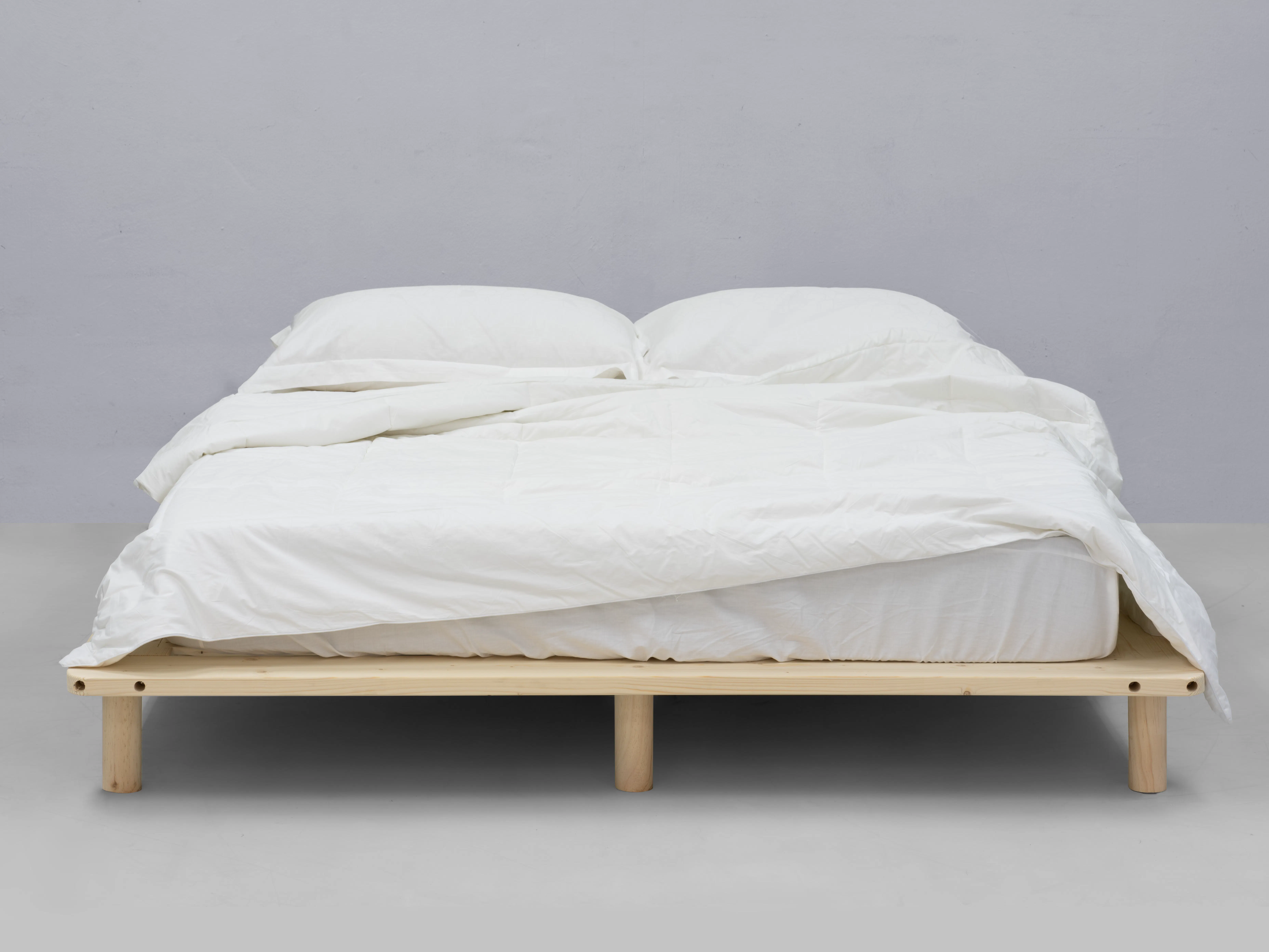
Platform Bed
A platform bed has a solid or closely-slatted surface built into a low frame, so the mattress sits directly on it without needing a box spring. The low profile gives a clean, modern look and a sturdy, even base. The surface works with most mattress types, though closely-spaced slats are best for foam.
Best for: A low, modern look and a no-fuss, sturdy base.
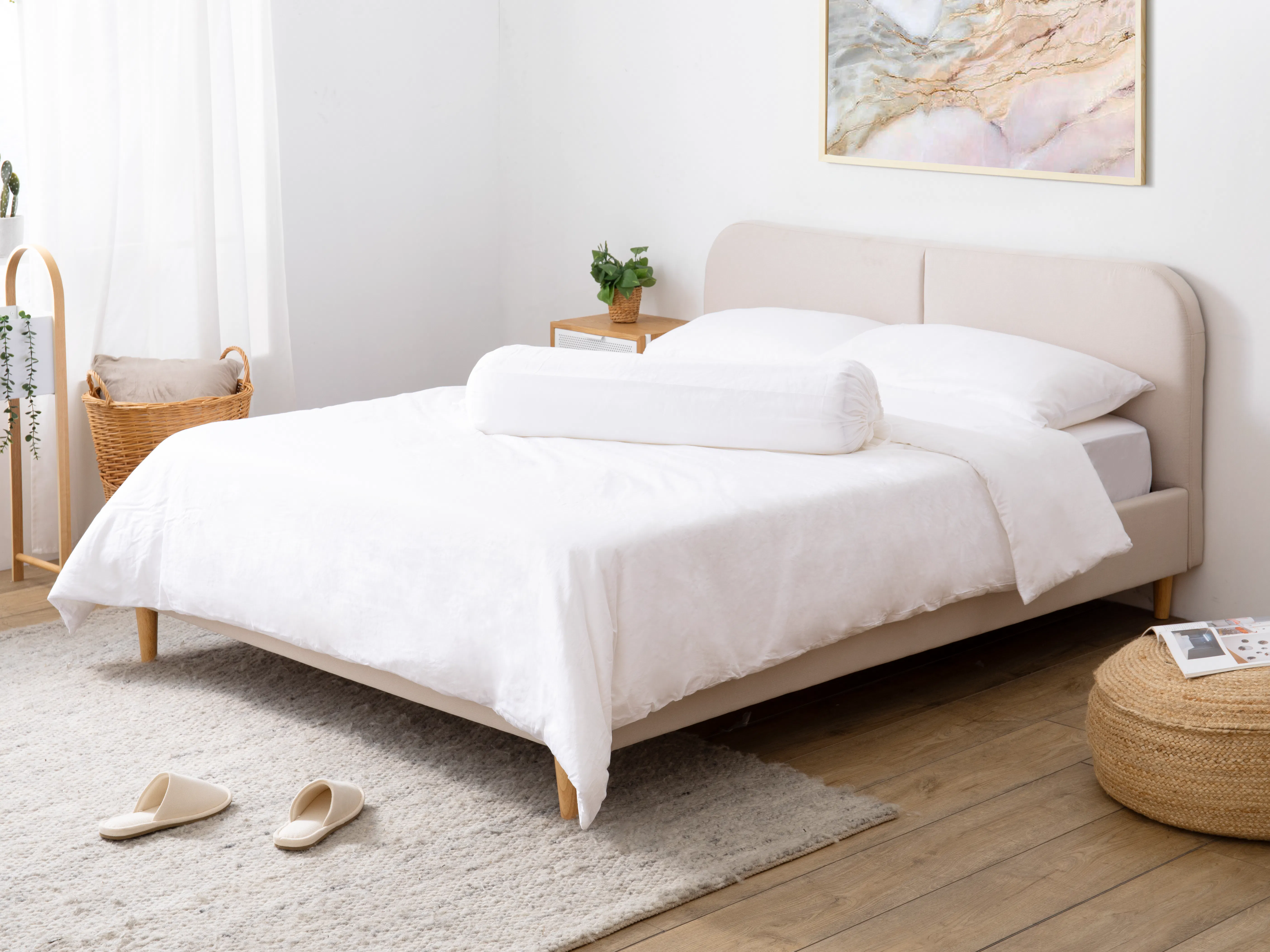
Divan Base
A divan base is an upholstered, solid-topped box that the mattress rests on, often with built-in drawers. It offers firm, even support across the whole mattress and a soft, finished appearance. Because the top is solid, it pairs naturally with spring mattresses.
Best for: Firm full-surface support and a tailored, upholstered finish.
Box Spring
A box spring is a sprung or solid wooden base, usually paired with a matching mattress, that absorbs shock and adds height to the bed. It takes some of the daily load off the mattress and lifts you to a higher sitting position. It is most common with traditional spring mattresses rather than foam.
Best for: Spring mattresses and anyone who likes a higher bed.
Slat vs platform vs divan vs box spring, cleared up: the difference is mostly how solid the surface is and whether the base is part of the frame. A slat base uses spaced slats for maximum airflow; a platform bed has a solid or closely-slatted built-in surface, with no box spring needed; a divan is a solid, upholstered box, often with drawers; and a box spring is a separate sprung base that sits under the mattress to add height and absorb shock.
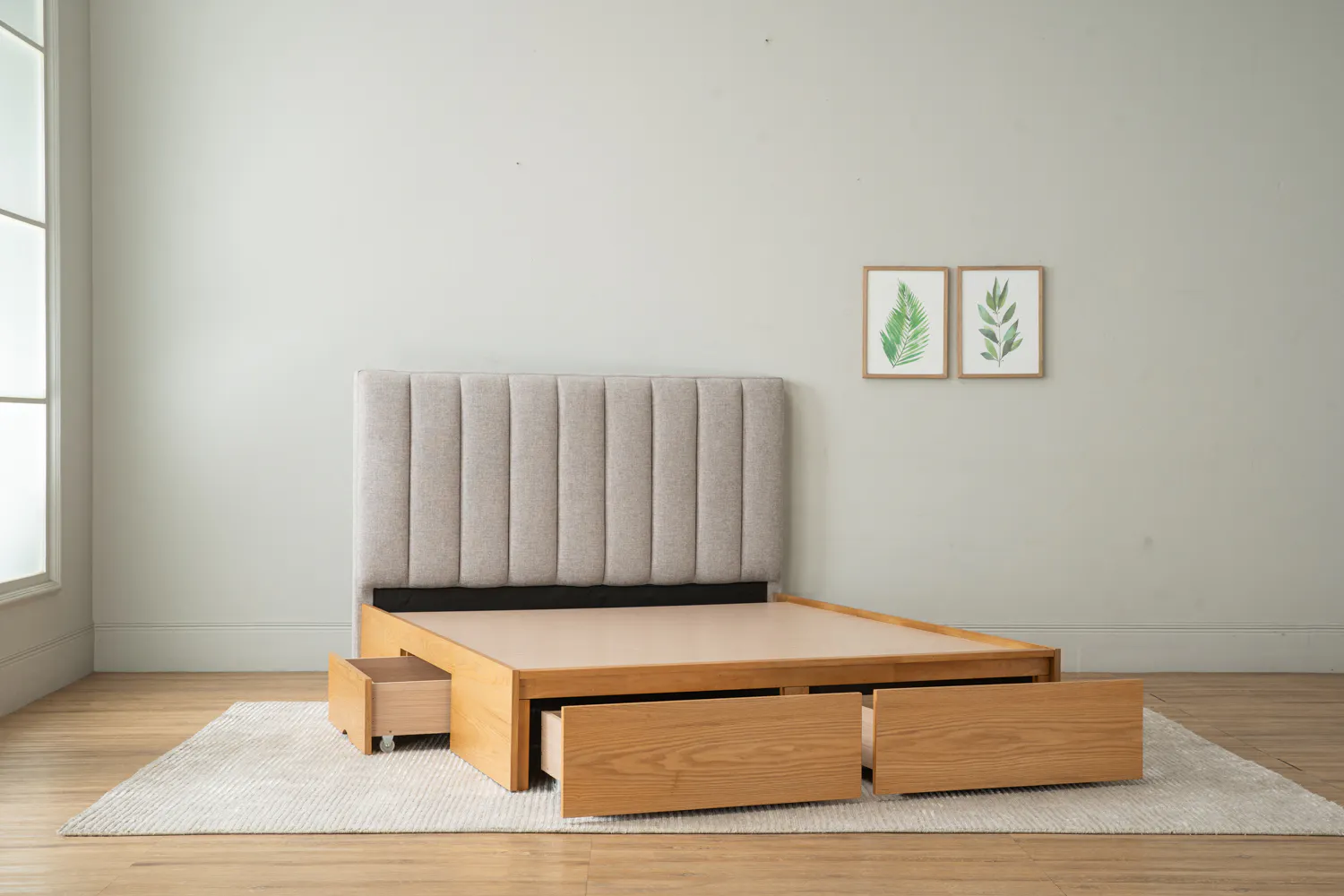
Storage Drawer Bed
A storage drawer bed builds drawers into the base, turning the space under the mattress into usable storage. It is a favourite in BTO and HDB bedrooms where every bit of space counts. Leave about 30 cm of clear floor on the drawer side so the drawers can pull out fully.
Best for: Small bedrooms that need extra storage without extra furniture.
Gas-Lift Storage Bed
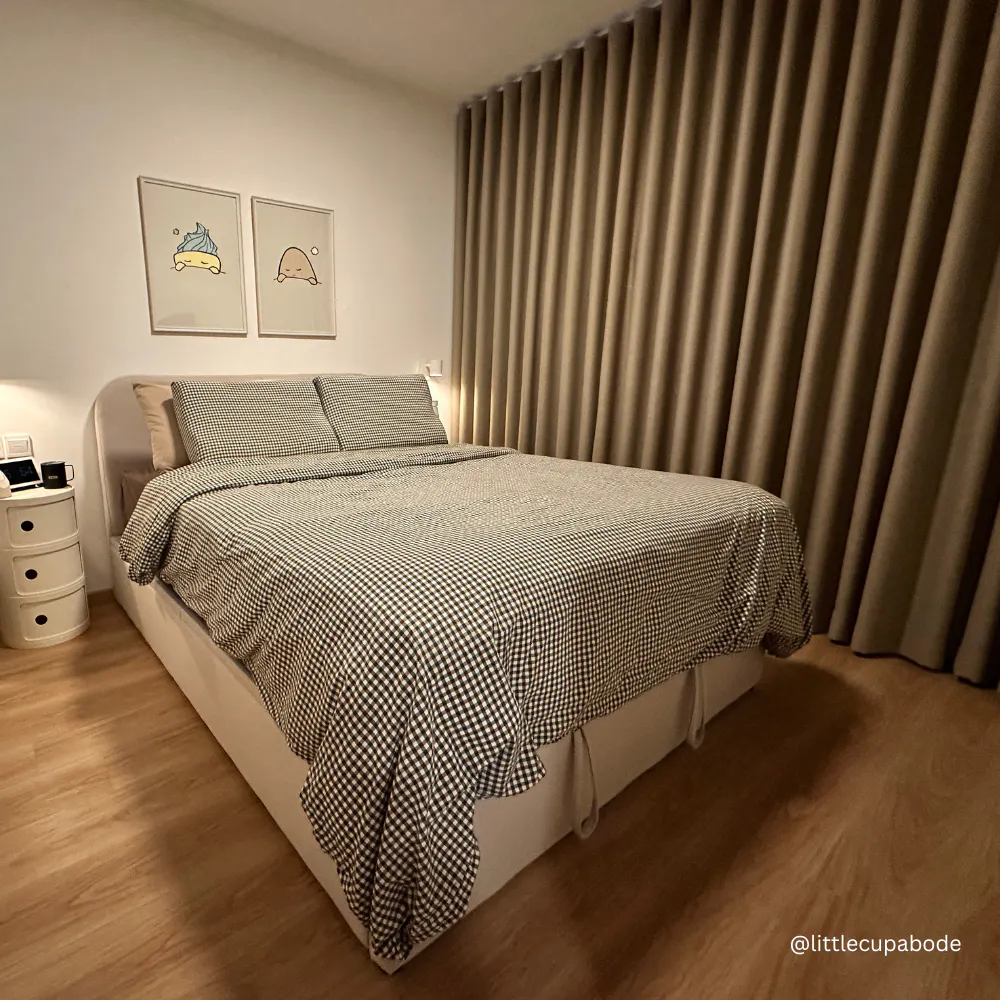
A gas-lift storage bed raises the entire mattress platform on hydraulic pistons to reveal a deep storage compartment underneath. It holds far more than drawers and needs no side clearance, which suits tight rooms. Lift the mattress every week or two so the underside can breathe in our humidity.
Best for: Maximum hidden storage in a compact room.
Adjustable Bed Base
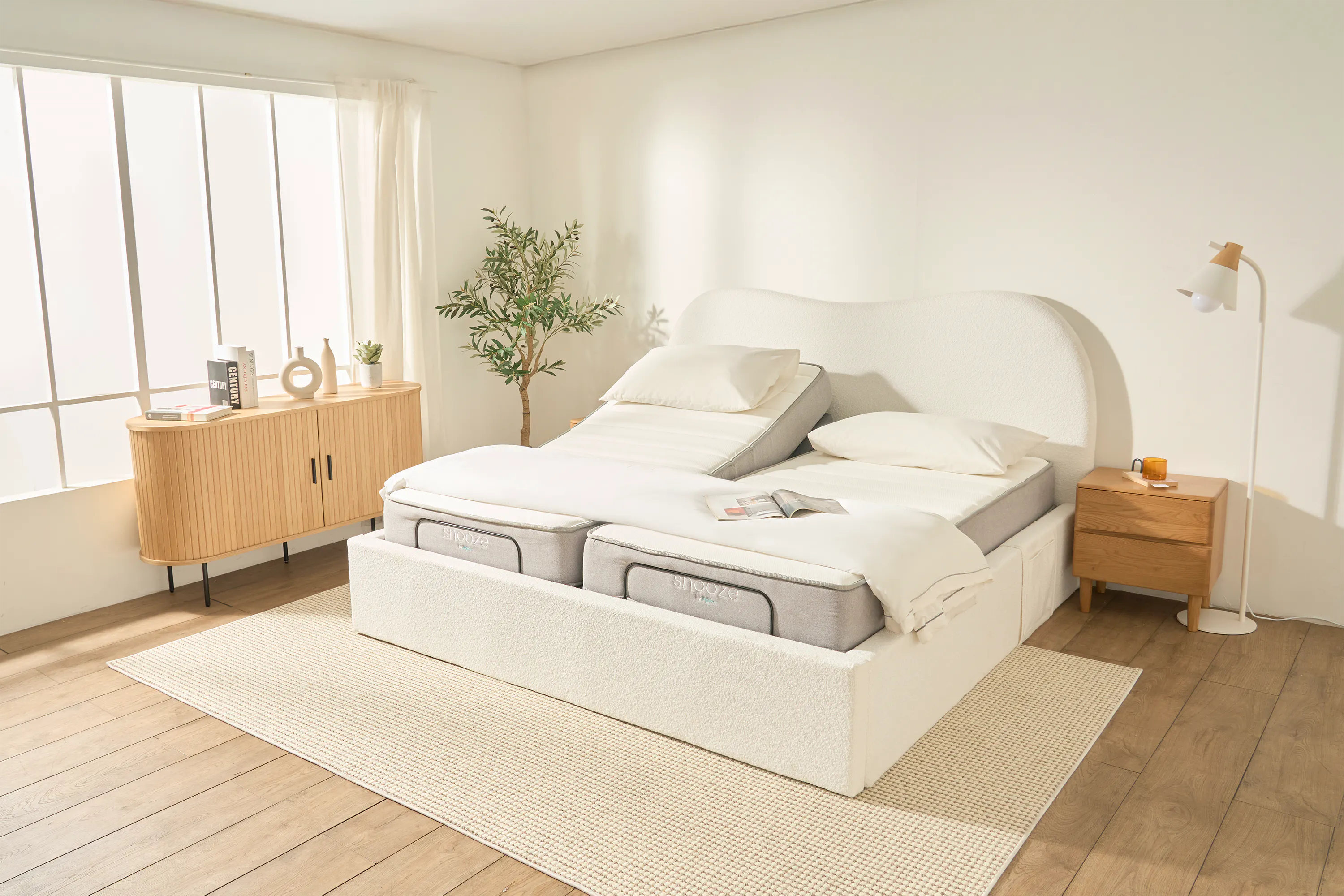
An adjustable bed base raises the head and foot of the mattress on a motor, letting you sit up to read or elevate your legs. It suits anyone who works, reads or watches TV in bed, or who has particular comfort or mobility needs. It only works with mattresses rated to flex, such as most foam models and pocket spring or hybrid mattresses with edge support.
Best for: Reading, working in bed, and tailored comfort.
Canopy / Four-Poster Bed
A canopy or four-poster bed has tall posts at each corner, sometimes joined overhead by a frame for draping fabric. It makes a dramatic statement and suits larger master bedrooms with ceiling height to spare. The base underneath is usually slatted, so it pairs much like a standard slat frame.
Best for: Spacious master bedrooms wanting a statement centrepiece.
Sleigh Bed
A sleigh bed is defined by its curved, scrolled headboard and footboard, which give it the silhouette of a sleigh. It is a classic, substantial design that anchors a traditional or transitional bedroom. It needs more floor space than a headboard-only frame because of the footboard.
Best for: Larger rooms and classic, traditional interiors.
Bed Frame Styles & Aesthetics
A dedicated look at bed frame styles is rare online, so here is the part most guides skip. These are eight different styles of bed frames and the concrete visual cues that define each, with a note on where each fits in a Singapore bedroom.
Minimalist / Contemporary
A minimalist bed frame keeps to clean straight lines, a low profile and a single solid colour, often with no footboard. It suits compact HDB and BTO bedrooms, where an unfussy silhouette keeps the room feeling open.
Mid-Century Modern
Mid-century frames feature a low platform, splayed tapered legs and warm wood tones, often walnut. The retro-warm look suits homes that pair wood furniture with a relaxed, lived-in feel.
Scandinavian
Scandinavian frames use light wood such as pale oak or ash, slim legs and soft, simple forms for an airy, uncluttered look. They pair naturally with the bright, neutral interiors common in local condos and new flats.
Japandi
Japandi blends Japanese calm with Scandinavian warmth: a low platform, natural matte wood and muted earthy tones. It suits restful, pared-back bedrooms built around fewer, better pieces.
Traditional / Classic
Traditional frames are defined by carved or turned wood, richer dark tones and a substantial headboard and footboard. They anchor formal bedrooms and homes that lean timeless rather than trend-led.
Industrial
Industrial frames combine a black metal frame, exposed bolts and boxy lines, sometimes with a wrought-iron headboard. The look suits loft-style condos and rooms with concrete, brick or dark accents.
Upholstered / Glam
Upholstered frames wrap the headboard, and often the base, in fabric or leather, frequently with a tufted or button-detailed headboard for a soft, luxurious look. They bring warmth and a hotel-like feel to a master bedroom, and modern performance fabrics make them far easier to live with than they once were.
Rustic / Farmhouse
Rustic frames feature thick, chunky wood with visible grain, often in a weathered or natural finish. They suit larger homes and anyone after a warm, homely, gather-round bedroom.
In a Singapore HDB or BTO, where you may keep the same bed for a decade or move it between homes, the styles that age best are the understated ones. Neutral wood tones and minimalist silhouettes stay relevant through changing trends and suit almost any future room, while bolder statement upholstered or glam styles can feel dated sooner. If you want one frame to last, lean towards the quieter end of the scale and let your bedding and decor carry the trends.
Bed Frame Materials
Material is the single biggest decision factor for a Singapore bed frame, because it determines how long the frame lasts, how it copes with humidity and termites, and whether it can be taken apart and rebuilt when you move. Before the materials themselves, three construction details separate a frame that lasts from one that loosens and squeaks.
Joinery & Fasteners
How the frame is joined tells you how long it will stay solid. Mortise-and-tenon or sturdy bolted joints hold up far better than staples and glue. Metal cam-locks on flat-pack frames are acceptable and convenient, but check and retighten them over time, as they can work loose.
Weight Rating & Slat Support
Quality frames carry a weight rating, typically 200 to 400 kg in total, which is a useful signal of how well they are built. Slats should be solid and evenly spaced at 5 to 7 cm, and on Queen and King sizes they should be supported by a centre rail to stop the base sagging under load.
Surface Finish
The finish protects the frame and shapes its look. Wood may be varnished, oiled or left unfinished; metal is either powder-coated or spray-painted; upholstery is either stain-treated or untreated. The finish you choose affects both durability and how much daily care the frame needs, as the next sections explain.
With those markers in mind, here is how each material performs in a Singapore bedroom, starting with the wood debate that trips up most buyers.
Solid Wood vs Engineered Wood
Bed frame wood splits into two broad camps: solid wood, milled straight from timber, and engineered wood, made from manufactured panels. The price gap between them is often two to four times, and the lifespan gap is wider still.
Solid Wood
Solid wood is single-piece timber, the most expensive option and the longest-lasting. It is also the easiest to repair, since a scratch can be sanded and re-oiled, and it is the right choice for a bed you want to keep for ten years or more.
Plywood
Plywood is built from thin layers of veneer glued in alternating directions, which makes it the strongest engineered wood and the most resistant to warping. It is a good mid-tier choice for slats and structural panels, where its strength matters more than its appearance.
MDF
MDF (medium-density fibreboard) has a smooth surface that takes paint and laminate well, but it absorbs moisture and can swell and warp within two to three years in a humid Singapore bedroom without aircon. It is best avoided for the structural parts of a frame.
Particleboard / Chipboard
Particleboard is the cheapest engineered wood, made of wood chips bound with glue, and it has very low humidity tolerance. It is common in flat-pack budget frames and is best avoided for anything you expect to keep beyond three to five years.
What to avoid: Cheap MDF or particleboard frames under SGD 200 will typically fail within two to four years in an HDB bedroom without aircon, as the internal screws strip out once the panels swell.
The buying rule is simple: if a listing does not state the wood type, check with the retailer before buying, so you know exactly what you are paying for rather than guessing.
Wood Species for Singapore Bed Frames
Not all solid woods cope with Singapore's humidity equally. Here are the five species you will see most often, ranked roughly from most affordable to most premium.
Rubberwood
Rubberwood is the affordable mid-range default in Singapore, and it is often unfairly dismissed. It is reasonably hard and reasonably humidity-tolerant once properly sealed, which makes it solid value for a first home. It is not naturally termite-resistant, so a good sealed finish matters.
Pine
Pine is the cheapest and softest solid wood, so dents and scratches accumulate faster than on hardwoods. It suits renters and short-term setups rather than a forever bed. Like rubberwood, it is not naturally termite-resistant and benefits from sealing.
Oak
Oak is a versatile mid-tier hardwood with good humidity tolerance and a light, adaptable grain that suits most styles. It is harder than rubberwood and pine and holds up well to years of daily use, with reasonable natural termite resistance too.
Teak
Teak is the premium choice and the most humidity- and termite-resistant solid wood, thanks to a high natural oil content that suits our climate well. It carries a significant price premium, and it is worth confirming the timber is responsibly sourced.
Walnut
Walnut is a mid-premium hardwood prized for its rich, dark grain and depth of colour, with reasonable natural termite resistance. It makes a striking centrepiece, though it sits at a higher price than oak and is a touch softer, so it shows knocks a little more readily.
Metal Bed Frames
Metal frames win on price, durability and humidity resistance, but the finish quality decides whether the frame stays looking good or starts shedding paint flakes within a year.
Steel Frames
Steel is the most common metal frame, lighter and cheaper, and available in tube or angle-bar form. Quality varies a lot with the gauge (thickness) of the steel and how cleanly it is welded, so a suspiciously light, thin frame is usually a sign of corners cut.
Wrought Iron Frames
Wrought iron is heavier and more decorative, often with curved scrollwork and a headboard as the showpiece. It is typically more expensive than steel and suits classic or industrial bedrooms that want a statement frame.
Finish quality matters as much as the metal itself:
- Powder-coating: Electrostatically applied and oven-baked, it is the most rust-resistant finish and does not chip easily. Quality manufacturers always specify it.
- Spray paint: Applied over a primer, it is cheaper but chips on impact and can flake in humid conditions. It is common on budget frames.
- Bare or galvanised steel: With no decorative coating, it is practical, very rust-resistant and industrial-looking.
Three quick checks in the showroom: lift the frame, since heavier usually means thicker steel; look at the welds and pick the cleanest; and ask whether the frame ships with rubber feet, which cut down squeaking and help deter bed bugs.
The buying rule: if a listing does not mention powder-coating, assume it is spray-painted.
Upholstered Bed Frames
Upholstered bed frames bring texture, softness and warmth that few other materials match, turning the headboard into the centrepiece of the room. They are the closest a bedroom gets to a hotel feel, and modern fabrics have made them far easier to live with in our climate than they used to be.
Fabric Upholstered
Fabric upholstery, in cotton, linen, polyester or velvet over a wooden internal frame, gives the softest, warmest look and the widest choice of colours. The real shift is in the fabric itself: today's performance fabrics, including pet-friendly and eco-clean weaves, resist stains and wipe down easily, which makes a fabric headboard practical even in a busy family bedroom. For homes with children who read or snack in bed, a performance fabric is the easy-care choice over untreated linen or cotton.
Genuine Leather Upholstered
Genuine leather wipes clean, feels cool and refined, and develops a handsome patina over the years. It sits at a premium price and rewards a little care, namely conditioning every 6 to 12 months to keep it supple in our humidity. It is the most durable and lowest-fuss of the upholstered options.
Faux Leather / PU Upholstered
Faux leather (PU or PVC) gives a similar look to leather at a lower price, which makes it tempting for a quick refresh. The trade-off is lifespan, since it tends to peel and crack within three to five years, and faster in a humid bedroom, so it suits short-term setups more than a long-term bed.
Keeping an upholstered frame fresh is straightforward: vacuum the headboard weekly with an upholstery attachment, and run aircon or a dehumidifier a few hours a day to keep the room comfortable and the fabric in good shape. A removable, washable cover makes upkeep easier still. If your bedroom has little airflow and no aircon, a performance fabric or a wipe-clean leather is the easier-living choice, with solid wood or powder-coated metal as dependable alternatives if you would rather skip upholstery altogether.
Material Comparison Table for Singapore Homes
Here is how the materials compare on the things that matter most in a Singapore bedroom.
| Material | Humidity Tolerance | Termite Resistance | Durability | Assembly / Disassembly | Indicative Price Band | Best-Fit Household |
|---|---|---|---|---|---|---|
| Solid teak | Excellent | Excellent (natural oils) | Excellent (15+ yrs) | Moderate, heavy | Premium | Long-term, premium homes |
| Solid oak | Good | Good | Very good | Moderate, heavy | Mid–Premium | Most homes, families |
| Solid walnut | Good | Good | Very good | Moderate, heavy | Mid–Premium | Statement bedrooms |
| Solid rubberwood | Good when sealed | Low, seal it | Good | Easy | Budget–Mid | First homes, value buyers |
| Solid pine | Fair when sealed | Low, seal it | Fair (soft) | Easy | Budget | Renters, short-term |
| Plywood | Good | Low | Good (structural) | Easy | Budget–Mid | Slats and frame parts |
| MDF | Poor, swells | Low | Fair (2–3 yrs) | Easy but fragile | Budget | Avoid for structure |
| Particleboard | Very poor | Low | Poor (3–5 yrs) | Easy but fragile | Budget | Very short-term only |
| Powder-coated steel | Excellent | Not applicable | Very good | Easy, knock-down | Budget–Mid | Most homes, humid rooms |
| Spray-painted steel | Fair, can rust | Not applicable | Fair, chips | Easy, knock-down | Budget | Short-term, low-cost |
| Wrought iron | Good if coated | Not applicable | Very good | Heavy, awkward | Mid | Classic, statement rooms |
| Fabric upholstered | Good with care | Frame-dependent | Good (performance fabric) | Moderate | Mid–Premium | Master bedrooms, comfort |
| Genuine leather upholstered | Good with care | Frame-dependent | Very good | Moderate | Premium | Premium, low-fuss luxe |
| Faux leather upholstered | Fair, can peel | Frame-dependent | Fair (3–5 yrs) | Moderate | Budget–Mid | Short-term refresh |
If you only have 30 seconds: solid rubberwood or powder-coated steel are the two safe defaults for most Singapore bedrooms.
Termites & Humidity in Singapore Bedrooms
Two risks affect bed frames in Singapore more than almost any other furniture: humidity, which warps engineered wood and rusts metal, and termites, which remain a genuine concern in older HDB blocks and landed homes. Most other guides skip both, so here is how to manage them.
Termite Risk
Some woods naturally resist termites and some do not. Teak, walnut and oak have good natural resistance, while pine, rubberwood and most engineered woods are more vulnerable unless treated. Treated or well-sealed wood is generally safe, and ground-floor HDB units and landed homes carry more risk than mid- and high-rise condos.
Humidity Risk
An unventilated Singapore bedroom can sit at 75 to 85 percent relative humidity during the rainy season, which is hard on the wrong materials. Engineered wood absorbs that moisture and swells, and metal frames with cheap finishes spot-rust at the joints. Running aircon three or more hours a day, or a dehumidifier, brings humidity down to a safer 55 to 60 percent.
Bed Frame Placement
Where you put the bed matters as much as what it is made of. Keep the frame 5 to 10 cm clear of external walls, which condense moisture, and avoid placing it directly under an air vent that can drip condensate. On storage and gas-lift beds, lift the mattress every week or two to let the underside breathe.
Bed Frame Sizing for Singapore Homes
The right bed frame size depends on three things: your mattress size, your bedroom dimensions, and whether the frame can actually get into the room past your lift and stairwell.
Singapore Mattress Sizes
Singapore mattress sizes follow their own standard, so it helps to know them before you shop. As a guide, a Single is about 91 x 190 cm, a Super Single about 107 x 190 cm, a Queen about 152 x 190 cm, and a King about 183 x 190 cm. These differ from US, UK and EU sizes, so check the centimetres rather than the label name when buying.
Bedroom Dimensions vs Bed Size
Choose a bed at least 10 to 15 cm longer than your tallest sleeper, so no one's feet hang off the end. Leave around 1 m of clearance on the sides you use to get in and out, and for storage drawer beds, add about 30 cm on the drawer side so the drawers open fully.
Guidance by Home Type
- 3-room HDB or studio BTO master bedroom: A Super Single or Queen fits comfortably.
- 4-room HDB or 2-bed BTO master bedroom: A Queen fits well, and a King is possible if you check the clearance.
- 5-room HDB, executive or condo master bedroom: A King fits with full clearance.
- Children's or secondary bedrooms: A Super Single is the usual standard.
Lift & Staircase Access
Access is the most common point where Singapore deliveries fail. Measure your HDB lift before ordering a King-size frame, and check for 90-degree turns in the corridor outside the lift. Knock-down, flat-pack frames solve most access problems because they go in as parts, while one-piece frames often will not fit.
Before you commit, mark the bed's footprint on your floor with masking tape, including the clearance on each side, and live around it for a day. It is the cheapest way to catch a too-big frame before it arrives.
Bed Frame & Mattress Compatibility
The wrong base can shorten a good mattress's life by years, so it pays to match the two. Here are the four compatibility rules that matter most.
- Bonnell spring mattresses suit a solid base. Bonnell spring mattresses, with their interconnected coils, are happiest on a solid, fully-supported base such as a divan, box spring or closely-slatted platform. A wide-gap slat base lets the coils flex unevenly and wear out faster.
- Pocket spring works with either base. Pocket spring mattresses, with their individually wrapped coils, are more forgiving and sit well on either a solid or a slat base. If you use slats, keep the gaps no wider than 7 cm so the springs do not dip into them.
- Memory foam and latex are happy on both, with airflow as a bonus. Foam and latex mattresses work on both solid and slat bases. Slats with 5 to 7 cm gaps, or a platform with ventilation cutouts, simply add airflow underneath, which helps the foam stay fresh in our humidity; a fully solid base is fine too, as long as you air the mattress now and then.
- Adjustable bases need a flex-rated mattress. An adjustable base only suits mattresses built to bend, such as most foam models and pocket spring or hybrid mattresses with edge-guard support. A standard rigid spring mattress on an adjustable base can suffer broken coils within months.
| Mattress type | Solid base | Slat (5–7 cm) | Slat (wide) | Adjustable |
|---|---|---|---|---|
| Bonnell spring | Best | OK | Avoid | Avoid |
| Pocket spring | Yes | Yes | Avoid | If flex-rated |
| Memory foam | Yes | Yes (airflow) | Avoid | Yes |
| Latex | Yes | Yes (airflow) | Avoid | Yes |
| Hybrid | Yes | Yes | Avoid | If edge-guarded |
One rule catches most buyers out: always confirm the slat spacing before buying a foam or hybrid mattress, because many mattress warranties are voided if the slat gap exceeds the manufacturer's stated maximum.
How to Choose Your Bed Frame
Here is how to choose a bed frame in Singapore in six steps, each built around one question you can ask yourself. It is the part to bookmark if you are still working out how to pick the right bed frame for your room.
- Start with your mattress: What will the frame support? Your mattress decides the base you need. Bonnell spring wants a solid base, pocket spring takes either, foam and latex are happy on both, and only a flex-rated mattress belongs on an adjustable base.
- Size it to your room: Which mattress size fits the space? Match the bed size to your bedroom and your tallest sleeper. A Queen suits most HDB and BTO master bedrooms, a King needs a 5-room flat or condo with clearance to spare, and secondary rooms usually take a Super Single.
- Decide on storage: Do you need space under the bed? If storage is tight, a storage drawer or gas-lift bed turns the space under the mattress into extra storage space. If not, a simple slat base, platform or divan keeps things lighter and cheaper.
- Match the material to your room's climate. Ask whether the bedroom is air-conditioned regularly. If not, lean towards solid wood or powder-coated metal, which shrug off humidity; if it is, upholstered and engineered-wood options open up more comfortably.
- Pick a style that suits the rest of the room. Look at your existing furniture, wood tones and overall mood, then choose a frame style that sits alongside them (see the styles section above). One coherent thread keeps the bedroom feeling pulled together.
- Set a realistic budget. As rough anchors, around SGD 200 buys an entry-level metal bed, about SGD 400 an engineered-wood frame, around SGD 800 a solid-wood frame, and about SGD 1,200 an adjustable base, with premium teak or upholstered frames running higher. Spending a little more on the joints and the finish usually buys years of extra life.
Still weighing it up? Check out our guide on how to choose the right bed size or you may read the FAQs below we hear most often.